Protein Science Group · Kansai Medical University

Mastering proteins. Pioneering new medicines.Why do similar receptors and ligands produce different responses?
Decoding selectivity — designing receptor modulators.

Selectivity, from structure to design.

How do GPCRs distinguish closely related ligands and receptor subtypes, and how do they select signaling pathways? We combine high-quality protein production, cryo-EM, and functional assays to investigate the structural basis of this selectivity. Working with research partners, we aim to translate these insights into antibodies, protein binders, and small molecules that selectively modulate receptor function.

Ryoji SunoAssociate ProfessorDepartment of Medical Chemistry, Kansai Medical University
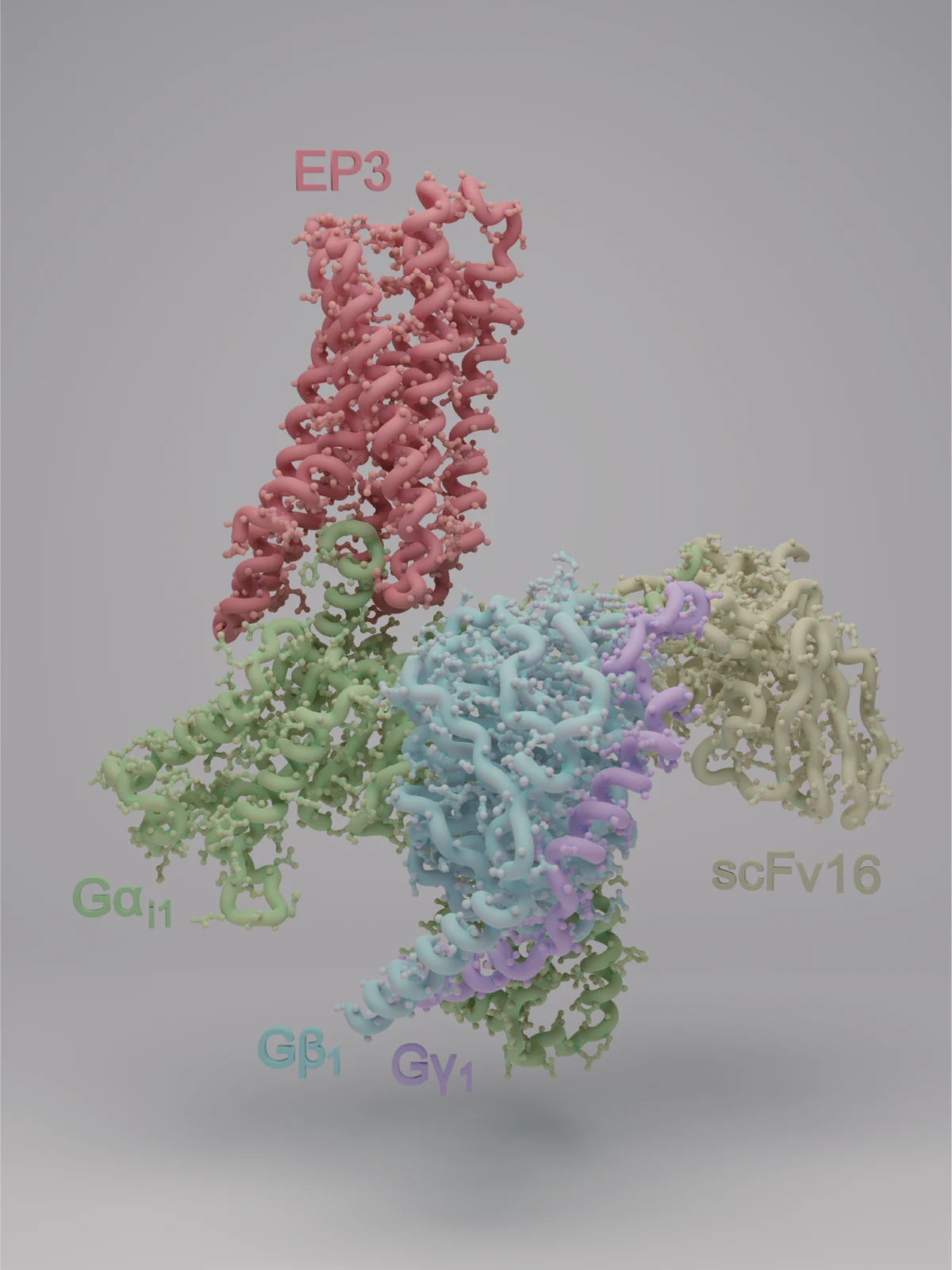
Prostaglandin E2 receptor EP3–Gi complex structure
Prostaglandin E2 receptor EP3–Gi signaling complexCell Reports (2022)

Our question

Why do similar receptors and ligands produce different responses?

Working out the principles of GPCR subtype and signaling selectivity from structure — and working toward modalities that control them.

Subtype selectivity

Receptor Subtype Selectivity

Orexin receptors OX1R/OX2R and muscarinic receptors M2/M3: among receptors whose orthosteric sites are highly conserved, we have identified from structure the residues and contacts that decide which subtype a ligand chooses.

Signaling selectivity

Signaling Selectivity (Biased Signaling)

κ-Opioid receptor: how different ligands bound to the same receptor choose between G-protein and β-arrestin signaling, and how that information travels from the ligand-binding pocket into the cell.

G-protein selectivity

G-Protein Selectivity

Prostaglandin E2 receptors EP3/EP2/EP4: how a receptor chooses between Gi and Gs, with residues in ICL2 and TM5 shown to decide the outcome.

We have deliberately studied several receptor families because general rules of selectivity can only come from comparison across them. The structural determinants we find translate directly into the design of subtype- and pathway-selective ligands and modalities.

News

News

Recent topics from the group: publications, awards, talks and more.

All news →

    What we can do

    What we can do

    Integrating in-house protein production, structural and functional studies with molecular discovery through research partnerships.

    Protein Production→Structure→Molecular Discovery→Drug Development

    Step 01 · Protein production

    High-Quality Protein Preparations

    For each target we build an expression system in insect or mammalian cells, prepare the membrane protein in defined functional states — active, inactive, ligand-bound — through solubilization, purification and complex formation, and confirm homogeneity, stability and activity before anything else begins.

    Step 02 · Structure

    Structures & Signaling Assays

    By cryo-EM we determine structures of ligand-bound states and signaling complexes, and combine them with signaling assays such as NanoBiT to pinpoint the residues and pathways that decide subtype and pathway selectivity.

    Step 03 · Molecular discovery

    Molecular Discovery & Design

    Using high-quality target preparations, we develop and evaluate antibodies and pursue AI-enabled de novo binder design. Monobodies and nanobodies are obtained through collaboration, while DEL-based small-molecule discovery is pursued with external partners. We aim to characterize promising candidates through structural and functional studies.

    Core expertise & approaches

    Protein science at the core, expanding toward broader drug targets

    We extend our membrane-protein production technology, and the structural analysis and molecular discovery built on it, from GPCRs to a wider range of drug targets.

    Protein production

    High-Quality Protein Preparations

    Expression-system construction in insect and mammalian cells, membrane-protein solubilization, purification and complex formation, and quality control — producing preparations that stand up to structural analysis and screening.

    Targets

    GPCRs & Membrane Proteins

    Major targets include opioid, orexin, prostaglandin E2, muscarinic and bombesin receptors.

    Structure

    Cryo-Electron Microscopy

    High-resolution structural determination of membrane proteins and signaling complexes for drug discovery.

    Function

    Functional & Signaling Analysis

    Quantitative analysis of ligand-dependent function and signaling selectivity, integrated with structural information.

    Molecular discovery

    Antibodies, Monobodies/Nanobodies, de novo Binders & Small Molecules

    We produce and evaluate antibodies and pursue AI-enabled de novo binder design in our laboratory. Monobodies and nanobodies are obtained through collaboration, and comparative DEL screening is performed with external partners. We evaluate candidate molecules through structural and functional studies.

    Drug development

    From Modalities to Medicines

    We refine these molecules by structure-based and AI-enabled design and develop them as functional modalities that control protein function, aiming at new medicines.

    Protein Science Group

    Protein Science Group

    Faculty, researchers, technical staff, graduate students and visiting students work together within the Department of Medical Chemistry at Kansai Medical University.

    Built on protein science, our research spans structural biology, pharmacology and molecular discovery to understand drug-target mechanisms and develop molecules that modulate their function.

    We actively welcome master's and doctoral students, working-professional doctoral students, and JSPS Research Fellows.

    • Team members10
    • Industry partners6
    • Core expertiseGPCR
    • Structural platformcryo-EM

    Collaboration

    Collaboration & Research Partnerships

    We collaborate with academic groups and have established research collaborations with six pharmaceutical and biotechnology companies. Projects can combine drug-target protein production, structural analysis, functional studies, and the discovery of function-controlling molecules — antibodies, de novo binders and DEL-derived small molecules — according to the scientific objective. Company names and individual project details are not disclosed on this website.

    Contact →