Why do similar receptors and ligands produce different responses? Decoding selectivity and designing receptor modulators.
Vision
From the selectivity of proteins to drug discovery
Proteins sustain life, and one of their most remarkable properties is selectivity. Proteins recognize differences as small as those between sodium and potassium ions, or between ATP and ADP, and discriminate between them with great precision to keep life going.
G protein-coupled receptors (GPCRs), the targets of many drugs, are no exception. Which of several closely related receptor subtypes a ligand binds, how a receptor tells near-identical ligands apart, and which of several signaling pathways it engages: these choices can influence drug efficacy and adverse effects.
We focus on this selectivity. Using structural biology as our central approach, we aim to explain at the molecular level how GPCRs and other drug targets generate selectivity, and to design modalities that control selectivity on the basis of that understanding, as our contribution to drug discovery.
The technical strength that makes this possible is the production of high-quality membrane-protein preparations in defined functional states. Starting from these preparations, we determine structures by cryo-EM, combine them with pharmacological assays to understand which structural state gives rise to which function, and generate antibodies, monobodies/nanobodies, AI-designed de novo binders and DEL-derived small molecules that discriminate between target states and functions, developing them as diverse modalities toward new medicines.
Selectivity, from structure to design — understanding molecular recognition and developing molecules to modulate protein function.
Protein Production
Producing high-quality protein preparations
Neither structural analysis nor screening can begin without protein that is homogeneous, stable and active. For each target we build an expression system — baculovirus-infected insect cells or mammalian cells — and carry the membrane protein through solubilization and purification to the formation of complexes with G proteins, antibodies and other partners.
Every preparation is checked for homogeneity (monodispersity), stability and ligand-binding activity before it is used for structure determination or binder screening. We believe this accumulated quality control is what makes high-resolution structures and reliable screening results possible.
Developed across many membrane proteins, GPCRs above all, this production technology also serves our collaborations, where we take on the preparation of target proteins.
Keywords: baculovirus–insect cell and mammalian expression / membrane-protein solubilization and purification / complex formation / quality control (monodispersity, stability, ligand-binding activity)
Selectivity & Mechanism
Understanding the mechanisms of selectivity from structure
Understanding a drug target requires knowing which conformations it adopts and how it interacts with ligands and signaling proteins. Using single-particle cryo-EM as a central platform, we determine high-resolution structures of GPCRs, other membrane proteins, and protein complexes.
We are particularly interested in forms of selectivity that are directly relevant to drug discovery: how different ligands bound to the same receptor preferentially engage G-protein versus β-arrestin signaling, how ligands distinguish among receptor subtypes within the same family, and how receptors select specific G-protein subtypes such as Gi or Gs.
Our studies have addressed biased signaling in KOR, ligand subtype selectivity in OX2R and the M2 muscarinic receptor, and Gi/Gs selectivity in EP3. By integrating structural analysis with pharmacology, molecular dynamics simulations, and spectroscopy, we aim to connect molecular recognition to intracellular signaling as a continuous mechanistic process.
Our work extends beyond structure determination to address ligand recognition, receptor subtype selectivity, G-protein selectivity, and biased signaling. The following studies illustrate how structural information can be connected to molecular function.
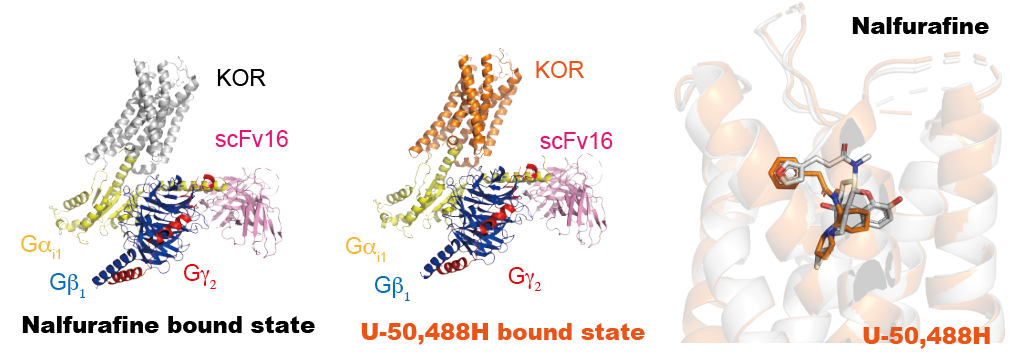
Fig. 1 · KOR–Gi · cryo-EM 2.76 Å / 2.90 Åκ-Opioid receptor (KOR): molecular basis of biased signaling
We determined nalfurafine- and U-50,488H-bound KOR-Gi complexes at 2.76 Å and 2.90 Å, respectively. By integrating cryo-EM, ATR-FTIR, NanoBiT functional assays, and MD simulations, we identified K2275.40, C2866.47, H2916.52, and Y3127.34 as key residues for β-arrestin recruitment and investigated how information is transmitted from the ligand-binding pocket to signaling selectivity.
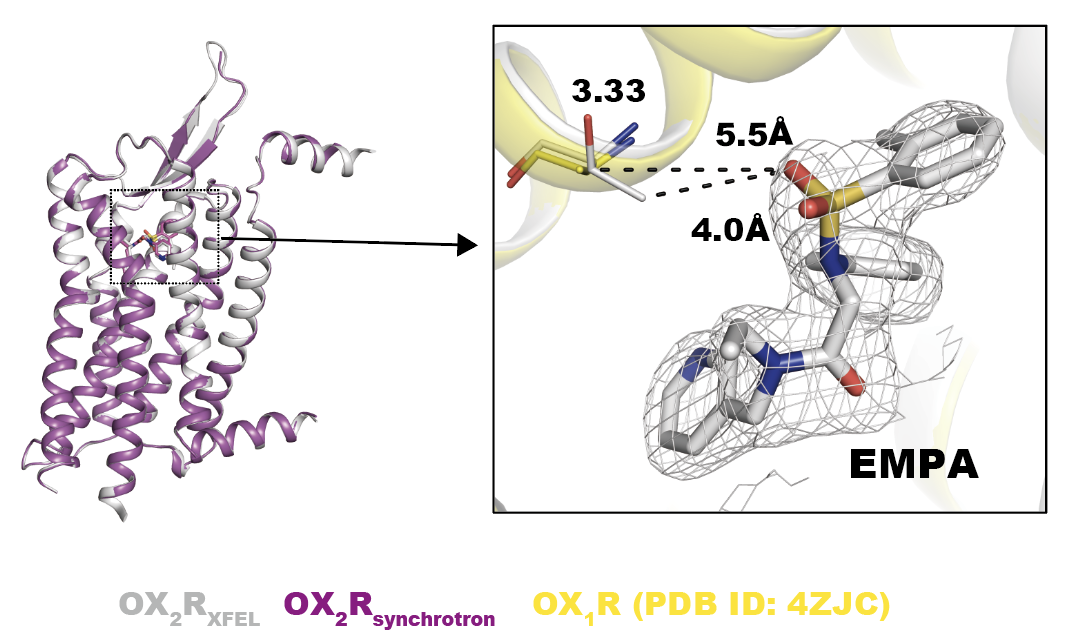
We determined the OX2R complex with the OX2R-selective antagonist EMPA using both synchrotron X-ray crystallography (1.96 Å) and serial femtosecond crystallography with an X-ray free-electron laser (XFEL; 2.30 Å). By comparing the higher-resolution synchrotron structure of OX2R with the synchrotron structure of OX1R determined by Rosenbaum and colleagues (PDB ID: 4ZJC), we further showed that the non-conserved residues at positions 2.61 and 3.33 are critical determinants of subtype selectivity. The figure highlights the EMPA-binding mode together with structural features underlying subtype selectivity.
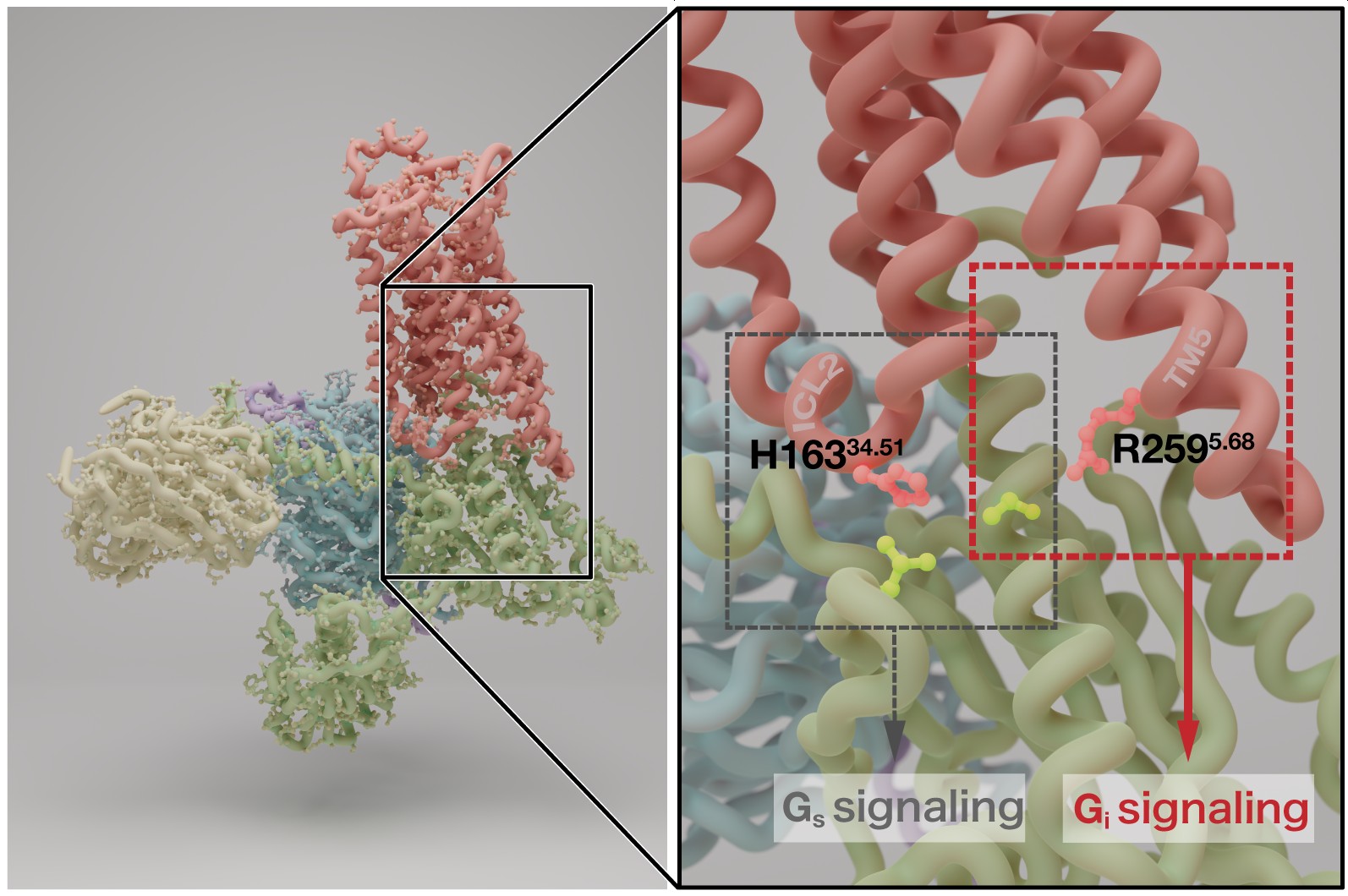
We determined the human EP3-Gi signaling complex at 3.4 Å. Comparison with EP2-Gs and EP4-Gs structures, together with mutational analysis, showed that positions 34.51 in ICL2 (H163) and 5.68 in TM5 (R259) contribute to Gi/Gs selectivity, providing structural insight into how receptors distinguish among G-protein subtypes. The figure shows the overall EP3-Gi complex and a close-up of the residues involved in selectivity.
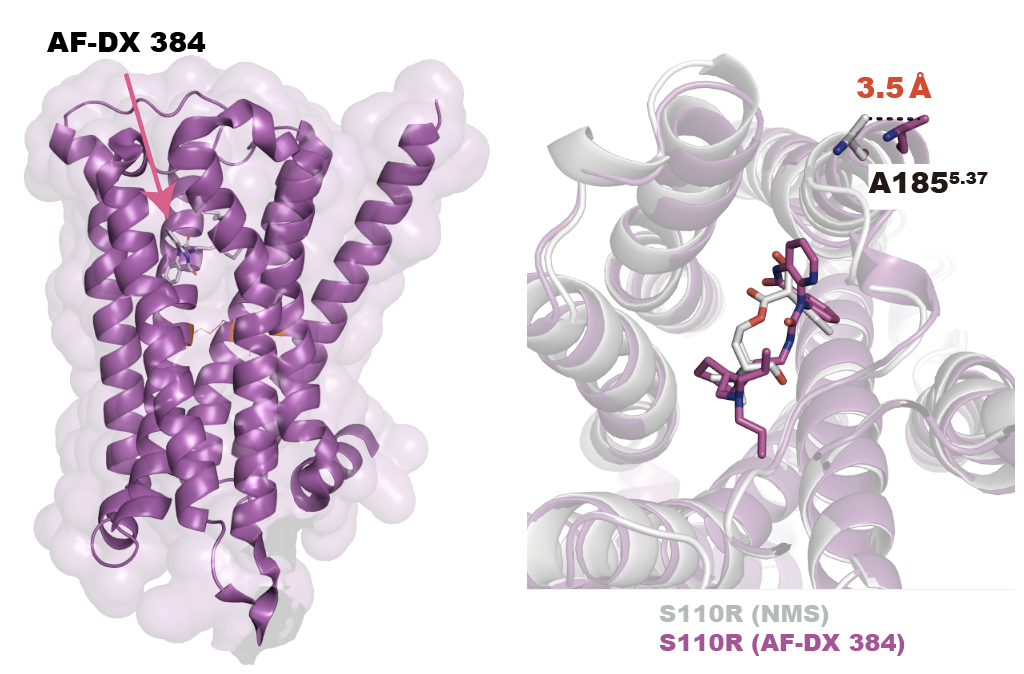
We determined structures of the M2 receptor bound to the subtype-selective antagonist AF-DX 384 and the non-selective antagonist NMS, and combined them with MD simulations and pharmacological analysis. Although the orthosteric-site residues are highly conserved across muscarinic receptor subtypes, tighter ligand-receptor contacts in M2 contribute to the subtype selectivity of AF-DX 384 over M3. The figure highlights the AF-DX 384-binding mode and structural features revealed by comparison with the NMS-bound state.
Image adapted from Suno et al., Nature Chemical Biology (2018); modified for this website.
Molecular Discovery
Creating molecules that control the target
High-quality target preparations provide a foundation for developing molecules that selectively modulate protein states and functions. We combine antibody work and AI-enabled binder design with collaborative discovery of smaller protein binders and comparative DEL screens performed by external partners.
Antibodies
Antibodies
We raise and screen antibodies in-house to obtain those that recognize a specific receptor conformation and control its function, as our allosteric EP4 antibody does. They serve as Fabs for structural analysis and as functional antibodies that modulate signaling.
Monobodies & nanobodies
Monobodies / nanobodies
Through collaboration we obtain small binders such as monobodies and nanobodies, which we use as tools to support structure determination and as modalities that act inside or outside the cell.
De novo binders
AI-designed de novo binders
Starting from structural information, we design protein binders to the target surface by AI-enabled de novo design, then express and evaluate them in-house.
Small molecules
Small molecules (DEL screening)
We prepare high-quality membrane-protein targets and work with external partners on comparative DNA-encoded library (DEL) screening. We then evaluate candidate compounds in-house through binding, functional, and mechanistic studies.
Each molecule is then validated by complex structure determination and functional analysis to establish its mechanism of action, and developed as a functional modality that controls protein function, with new medicines as the goal.
Keywords: antibody production / monobodies and nanobodies (collaboration) / AI-enabled de novo binder design / small molecules by DNA-encoded library (DEL) screening / functional modalities
Current Directions
From structure to function-modulating modalities
We are extending our structural and functional platforms toward the development of molecular modalities that selectively modulate target-protein states and signaling outputs. Rather than treating structure determination as the endpoint, we iterate between protein production, structural analysis, functional evaluation, and molecular discovery to connect Protein Production → Structure → Molecular Discovery → Drug Development.
Our current work spans multiple modalities — antibodies, monobodies/nanobodies, AI-enabled de novo binders and DEL-derived small molecules — together with structure-based drug discovery (SBDD) and computational approaches to establish new principles and modalities for modulating protein function, and to develop them into new medicines.
Multiscale physiology
From the Transformative Research Area “Multi-scale platform for untangling physiological complexity”
Within the MEXT/JSPS Transformative Research Areas (B) program, Multi-scale platform for untangling physiological complexity, we worked to connect ligand-induced receptor structural changes with signaling, cellular responses, and organism-level effects across multiple scales. As principal investigator of the A01 project on rapid structural analysis of transient protein complexes, we developed structural approaches to capture functional protein complexes formed in distinct signaling states.
As one of the early outputs from this research area, we reported a structural and functional study of ligand-dependent signaling selectivity in KOR. Major additional results from the project are currently being prepared as multiple manuscripts.
We are now extending these advances toward integrated drug-discovery research that links Structure → Function → Modality.
From an allosteric EP4 antibody to functional modalities
For the prostaglandin E2 receptor EP4, we determined the structure of the receptor in complex with the inhibitory antibody Fab001 at 3.2 Å and showed that an antibody bound to the extracellular surface can allosterically regulate orthosteric ligand binding and signaling.
Building directly on our original work on EP4 allosteric inhibition, we aim to use the inhibitory antibody-defined receptor state to guide comparative DEL screening, testing whether small molecules can reproduce the antibody’s regulatory effect. Candidate molecules will be assessed through functional and structural studies.
We have studied several receptor families — opioid, orexin, prostaglandin E2, muscarinic and bombesin receptors — because general rules of selectivity can only be drawn from comparison across families. GPCRs form the core of our research platform, while we are expanding toward membrane proteins and protein complexes in which structural biology can reveal new principles for drug discovery. A defining feature of the Protein Science Group is that we treat protein production, structural analysis, functional evaluation, and molecular discovery as one continuous research process — and that it starts with the technology to produce high-quality preparations.
Research targets
GPCRs at the core, expanding toward broader drug targets
Our major GPCR targets include opioid, orexin, prostaglandin E2, muscarinic, and bombesin receptors. We investigate ligand recognition, receptor activation, signaling selectivity, and subtype selectivity from both structural and functional perspectives.
Beyond GPCRs, we are expanding toward membrane proteins and protein complexes for which structural information can reveal new mechanisms of regulation and new opportunities for drug discovery.
Integrated platform
Connecting production, structure, function, and molecular discovery
Our platform combines high-quality membrane-protein production, single-particle cryo-EM, GPCR signaling assays, antibody production, AI-enabled de novo binder design, structure-based drug discovery, and molecular dynamics simulations. Monobodies, nanobodies, and comparative DEL screening are pursued with external collaborators and service partners.
Rather than using these technologies in isolation, we cycle through Production → Structure → Function → Molecular Discovery to analyze drug targets from multiple angles and generate modalities that can be developed into medicines.
Targets: opioid / orexin / prostaglandin E2 / muscarinic / bombesin receptors and broader drug targets. Platform: protein production (expression, purification, complex formation, QC) / cryo-EM / pharmacology / antibody production / AI-based de novo binder design / SBDD / MD; monobodies, nanobodies and comparative DEL screening with external partners.
Collaboration
Academic & Industry Collaboration
We pursue collaborations in drug-target protein production, structural analysis, functional studies, the discovery of function-controlling molecules (antibodies, de novo binders and DEL-derived small molecules), and structure-guided drug discovery.
6Industry partners
We have established research collaborations with six pharmaceutical and biotechnology companies. Projects can also begin from partner-provided targets, compounds, or antibodies. Company names and individual project details are not disclosed on this website.